Switch to our home based website

Our programs

Browse catalog

Share |

Join our mailing list


Support forums

Have questions about grammar or ideas on implementing the MCT Curriculum?

Visit the support forums

Latest forum posts

Teaching an "Island" & "Town" student at the same time
06/06/2013 03:31:17
by Cheryl

Necromancy:Devotion
03/06/2013 17:39:54
by Gayle

Applying Problem Based Learning
30/05/2013 18:54:03
by Linda J

What others are saying about Royal Fireworks Press
Switch to our home based website

Death of Old Man Hanson

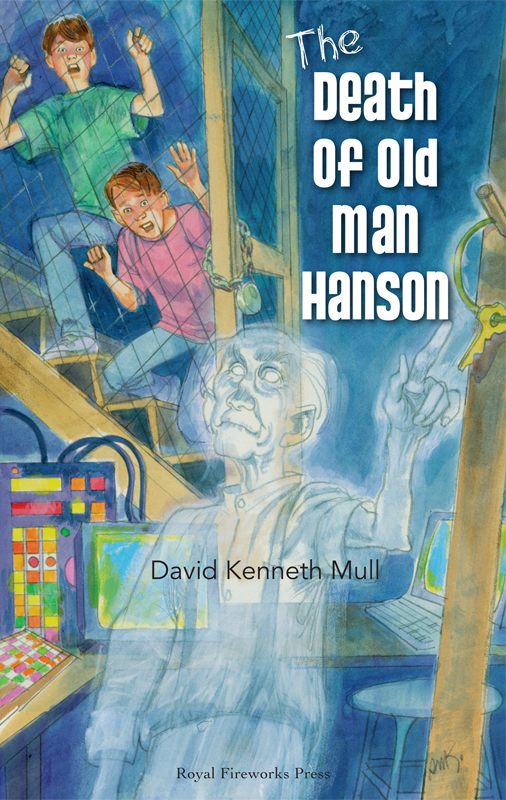
Death of Old Man Hanson Cover
Author:
Mull, David Kenneth
Subjects:
Creative Problem Solving; Values; Social relationships
Age:
9, 10, 11, 12
Grade:
4, 5, 6
Order code:
1188
Price:
$9.99
Online Price:
$7.99
Class sets:
10 or more: $7.00 each. (Order code: 1188S)

“...an excellent book” Ohioana Library Association

Here is a romp for smart, pre-teen boys with a twinkle in their eyes and harmless, well-planned pranks in their hearts.

Old Man Hanson is a recluse, but his orchard has some of the best apples around, and he protects them mightily from the “neighborhood five” who never tire of trying to steal some—even though their attempts are doomed to failure. Getting the apples becomes a duel of wits and the boys form the GOH (Get Old Man Hanson) Club. Plots and count-er plots, pranks and counter-pranks propel the humorous story. When Old Man Hanson dies, curiosity leads the storyteller, Sam, and his buddy, Bill, into Hanson’s house. In the midst of their snooping they experience Hanson’s best prank—they are trapped and must use their wits to escape within a specified time. They do escape, and the reader roars at the mental hijinks they go through.

Later, at the reading of Hanson’s will, his final prank’s motivation becomes clear. He was a genius, a rich and lonely man, with only a short time to live. The boys added fun to his last years. The tricks they played were harmless, thought-provoking and humorous, and at no time malicious. To thank them, he bequeaths to them his orchards as a business, his small but fine personal library, and college tuition for certain studies. To benefit the community and the children, the orchard business is to be self-perpetuating, for as each child turns 18, another neighborhood child is to be chosen by the new adult as his replacement.

Respect for mental agility bridges the age differential. While enjoying the pranking youngsters problem-solving abilities, Hanson planned to nurture those abilities for their future happiness and for the happiness of other children like them. When they matured, each group of youngsters would respect Hanson’s genius and purpose and carry it on for the next wave of young, creative thinkers.

David Kenneth Mull is a resident of Ohio. He was a teacher in the Akron Public School system for thirty years. He writes: "While I was teaching fifth grade, I decided to write this novel for the kids in my classroom. I meant it to be a fun, short, non-threatening book that they would want to read. It proved to be a wonderful teaching tool and an encouragement for the kids in my classes to be writers."

He is also the author of two new books for Royal Fireworks Press in a series: Charlie Cliche's Oft'told Tales

“...an excellent book” Ohioana Library Association

Here is a romp for smart, pre-teen boys with a twinkle in their eyes and harmless, well-planned pranks in their hearts.

Old Man Hanson is a recluse, but his orchard has some of the best apples around, and he protects them mightily from the “neighborhood five” who never tire of trying to steal some—even though their attempts are doomed to failure. Getting the apples becomes a duel of wits and the boys form the GOH (Get Old Man Hanson) Club. Plots and count-er plots, pranks and counter-pranks propel the humorous story. When Old Man Hanson dies, curiosity leads the storyteller, Sam, and his buddy, Bill, into Hanson’s house. In the midst of their snooping they experience Hanson’s best prank—they are trapped and must use their wits to escape within a specified time. They do escape, and the reader roars at the mental hijinks they go through.

Later, at the reading of Hanson’s will, his final prank’s motivation becomes clear. He was a genius, a rich and lonely man, with only a short time to live. The boys added fun to his last years. The tricks they played were harmless, thought-provoking and humorous, and at no time malicious. To thank them, he bequeaths to them his orchards as a business, his small but fine personal library, and college tuition for certain studies. To benefit the community and the children, the orchard business is to be self-perpetuating, for as each child turns 18, another neighborhood child is to be chosen by the new adult as his replacement.

Respect for mental agility bridges the age differential. While enjoying the pranking youngsters problem-solving abilities, Hanson planned to nurture those abilities for their future happiness and for the happiness of other children like them. When they matured, each group of youngsters would respect Hanson’s genius and purpose and carry it on for the next wave of young, creative thinkers.

David Kenneth Mull is a resident of Ohio. He was a teacher in the Akron Public School system for thirty years. He writes: "While I was teaching fifth grade, I decided to write this novel for the kids in my classroom. I meant it to be a fun, short, non-threatening book that they would want to read. It proved to be a wonderful teaching tool and an encouragement for the kids in my classes to be writers."

He is also the author of two new books for Royal Fireworks Press in a series: Charlie Cliche's Oft'told Tales

You may also like

You may also like