
Sign in for exclusive products and special discounts.
Is MCT Charlotte Mason Friendly?
A Thoughtful Look at Michael Clay Thompson for Charlotte Mason Families
Charlotte Mason parents often ask an important question before adding any new material to their homeschool:
Will this respect my child’s mind?
Michael Clay Thompson’s MCT language arts curriculum is not a Charlotte Mason curriculum in the strict, historical sense. However, many families find that MCT aligns beautifully with Charlotte Mason principles, especially when used as a language arts curriculum that complements a living-books education rather than replaces it.
Let’s take a closer look.

Shared Values Between MCT and Charlotte Mason
Although developed independently, the MCT and Charlotte Mason philosophies overlap in meaningful ways.
1. Respect for the Child’s Intelligence
Charlotte Mason believed that children are capable of engaging with real ideas. MCT is written with that same sense of respect. Rather than simplifying concepts to the point of emptiness, MCT introduces students to authentic grammar, vocabulary, writing, poetics, and literature and trusts them to rise to the challenge.
Students are invited into ideas, not talked down to or confined to busywork.
2. Language as an Art, Not a Set of Tricks
Charlotte Mason emphasized beauty, richness, and meaning in education. These same principles are at the heart of the MCT curriculum. Further, MCT treats language as a unified art form, weaving together:
- Grammar
- Vocabulary
- Writing
- Poetics
- Literature
Rather than isolating skills, MCT shows students how language works as a whole. This integrated approach resonates strongly with Charlotte Mason families who value depth over fragmentation.
3. Living Ideas and Quality Texts
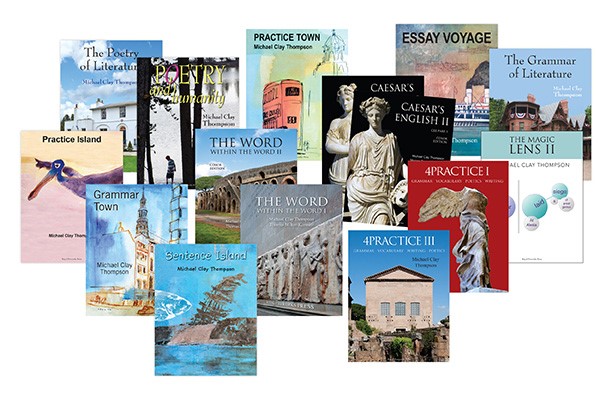
Charlotte Mason emphasized living books, or works written by authors with something real to say. Michael Clay Thompson’s books are built on the same principle. Every MCT text, whether it focuses on grammar, vocabulary, writing, poetics, or literature, is written as a living work in itself, rich with language, humor, and ideas worth exploring.
Students encounter authentic sentences, classic literature, and thoughtful commentary that invite attention and reflection. Rather than relying on formulaic prompts or artificial passages, MCT immerses students in real writing so that language study grows naturally out of meaningful, engaging texts.
4. Depth Instead of Drill
Charlotte Mason warned against the overuse of drills and mechanical repetition. MCT also shuns rote exercises and instead focuses on:
- Clear explanations
- Conceptual understanding
- Thoughtful practice
The goal is mastery through understanding, not memorization for its own sake or simply for the sake of passing tests. Many families find that this reduces burnout while improving retention.
Where MCT Differs from a Traditional Charlotte Mason Approach
Charlotte Mason families should also understand where MCT takes a different path.
1. Diagramming
Both Charlotte Mason sentence diagramming and MCT’s four-level sentence analysis are concerned with helping students understand how sentences are constructed rather than simply memorizing rules. In both approaches, grammar is taught as a way to reveal meaning—showing how words relate to one another and work together to express ideas.
Sentence diagramming does this visually by arranging words in a diagram that shows their grammatical relationships on the page. MCT’s four-level analysis achieves the same goal conceptually: students identify the parts of speech, parts of the sentence, phrases, and clauses in sequence, focusing on the fundamental binary structure of the sentence and how each part relates to the others within that structure.
2. Structure and Scope
MCT is a complete language arts curriculum that has a strong ethos, but it is not itself a teaching philosophy. It provides a clear scope and sequence, which some Charlotte Mason families appreciate, especially when teaching grammar, vocabulary, and writing explicitly.
Families who prefer an informal or narration-only approach to language arts may choose to use MCT selectively rather than in full.

How Charlotte Mason Families Commonly Use MCT
Many Charlotte Mason homeschoolers successfully integrate MCT by:
- Using MCT for grammar, vocabulary, and writing instruction
- Continuing to use their own living books for history and literature or selectively incorporating MCT literature
- Allowing plenty of time for discussion and reflection
- Moving at a thoughtful pace rather than rushing through lessons
In this way, MCT becomes a strong academic spine for language arts while preserving the spirit of a Charlotte Mason education.
Is MCT a Good Fit for Your Charlotte Mason Homeschool?
MCT may be a particularly good fit if you:
- Value ideas, beauty, and clarity in language instruction
- Want children to understand why language works, not just how it does
- Prefer depth over busywork
- Are homeschooling gifted or advanced learners who need real intellectual nourishment
It may be less ideal if you are seeking a purely narration-based or minimal-structure approach to language arts.
A Complement, Not a Compromise
For many Charlotte Mason families, MCT is not a departure from their philosophy but a natural ally. It respects the child, honors real ideas, and treats language as something worth knowing deeply.
Used thoughtfully, MCT can support a Charlotte Mason homeschool without compromising its heart.
Explore MCT, and discover how it can enrich your Charlotte Mason approach to language arts.