
Sign in for exclusive products and special discounts.
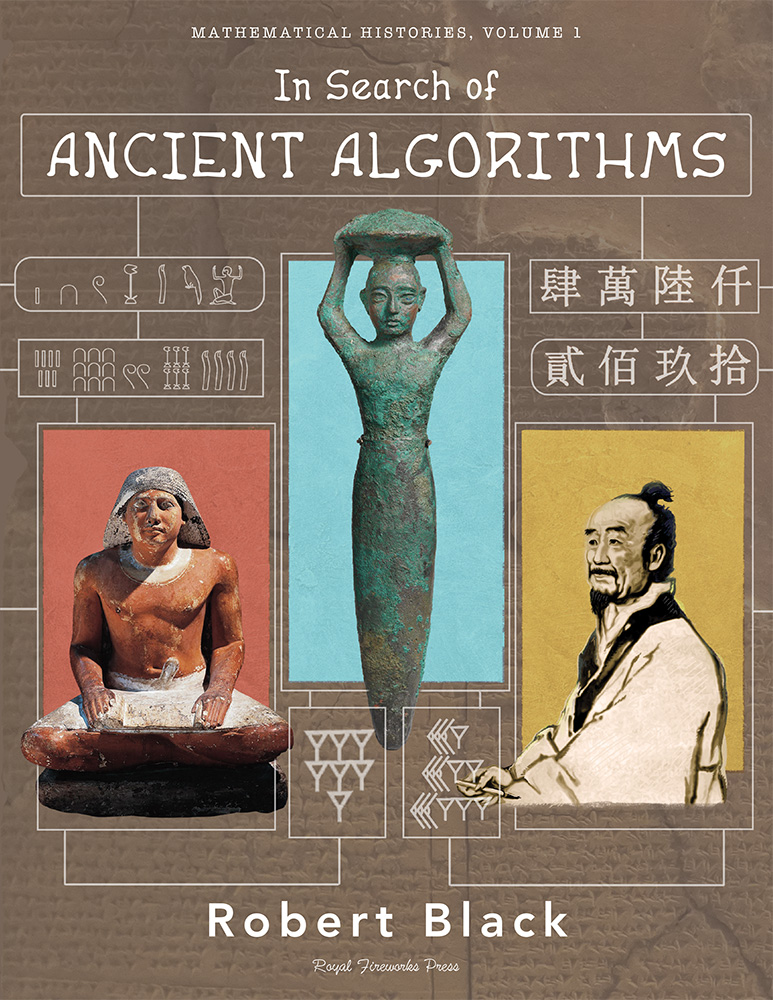
In Search of Ancient Algorithms
Mathematical Histories, Volume 1
$25.00
Order Code: 3099
Class sets 10 or more paperback books: $21.50 each
Class set order code: 3099S
Class set order code: 3099S
NOW AVAILABLE FOR PREORDER.
ARRIVES BEFORE CHRISTMAS!
Math has always been the same, but the ways people have thought about it, used it, and written it down have not. Take a tour of the ancient world, and discover how three of the great civilizations worked with numbers. Along the way, you’ll encounter a mathematically talented Sumerian king, an ordinary Egyptian scribe, and a Chinese scholar tasked with restoring his kingdom’s lost knowledge. Some things will look very different, but you may be surprised by what looks familiar!
Description
NOW AVAILABLE FOR PREORDER.
ARRIVES BEFORE CHRISTMAS!
As young children, one of the first things we learn to do is count. When we start school, we’re taught to add, then subtract, then multiply and divide. And throughout it all, rarely do any of us consider that someone had to do all of those things for the very first time. Ever.
In math, 2 + 2 = 4, and it has always equaled 4, but different civilizations came to that discovery in different ways. They wrote their numbers differently, they calculated math problems differently, and they recorded what they knew differently. There was an impressive variety in these methods, based in large part on what tools and materials were available and what was important to the people in that place during that time.
This book takes readers on a tour through three such ancient civilizations: the Sumerians in Mesopotamia, the Egyptians, and the Chinese. They were not the only ones to develop mathematics, nor were their mathematics necessarily the most advanced, but they provide a good look at the different ways in which people first worked with numbers.
Readers will delve into the history of each of these civilizations to discover why they came to math in the ways that they did. What problems were they trying to solve? What did they need the math for? What resources were available to assist in performing calculations and documenting both methods and results? Who benefited from the advancements in mathematical understanding, and how?
Author Robert Black explores each of these questions, giving readers an illuminating look at the intersection of math and history. The book is rich in full-color photographs and intriguing drawings, many of which illustrate how the number systems and mathematical processes of all three civilizations worked. Black uses these to walk readers through an array of math problems recovered from ancient texts. The end of the book includes four “Doing the Math” exercises using those same types of problems so that readers can try out the math for themselves.
There are some things that we’ll never know—methods and rationales that have been lost to history—but what we do know offers a fascinating glimpse into the mathematics of the past, which has provided a foundation for the math we use today, as we reach forward into the future.
Details
Reviews
More info
Sample Pages
-
In Search of Ancient Algorithms · View In Search of Ancient Algorithms · Download In Search of Ancient Algorithms


